By Lumpe Media
Kampala, January 26, 2026 — President Yoweri Kaguta Museveni has announced that about 70 percent of Ugandans are now engaged in the money economy, crediting the milestone to four decades of National Resistance Movement (NRM) leadership and sustained government-led wealth creation initiatives.
The President made the remarks on Monday while addressing crowds at the 40th Liberation Day celebrations held at Kololo National Ceremonial Grounds. He said Uganda’s economic journey since 1986 has moved steadily from post-conflict recovery to diversification, value addition and the gradual transition toward a knowledge-driven economy.
The national celebrations, held under the theme “Tribute to the Patriots who ushered in a fundamental change,” came shortly after President Museveni’s re-election in the January 15 polls, in which he was declared winner with about 71 percent of the vote.
In his speech, President Museveni thanked God and the electorate for the successful completion of the electoral process and applauded NRM supporters for backing the party and its candidates.
He described the election outcome as a decisive political victory but raised concern over what he termed low turnout among NRM supporters, noting that internal party figures suggested a much higher number of sympathisers were eligible to vote.
Although he secured roughly eight million votes, President Museveni said party records indicated that up to 18 million NRM supporters were ready to participate, but many failed to turn up on polling day.
“Some of our supporters did not vote. That is why I keep asking: where are the rest of the votes?” he said.
The President attributed the low turnout to intimidation by opposition activists in some areas and indiscipline among sections of the NRM leadership. He claimed that some supporters were threatened during the campaign period while security agencies failed to intervene promptly.
He also criticised what he described as selfish conduct by certain party leaders, which he said discouraged citizens from exercising their civic duties.
Turning to the economy, President Museveni said Uganda was currently recording annual growth of about seven percent, with expectations of faster expansion once oil production begins.
“The economy is moving very fast. With oil, we shall enter double-digit growth. This year, your oil will start flowing,” he said, adding that Uganda had resisted external pressure aimed at controlling its petroleum resources.
Despite the progress, he acknowledged that a significant number of Ugandans remain trapped in subsistence production. He traced the challenge to colonial economic structures that excluded the majority of Africans from meaningful participation in the money economy.
At independence in 1962, he said, only about nine percent of Ugandans were involved in commercial activity. While the figure rose gradually, major gains were realised after the NRM introduced targeted wealth creation programes, beginning with initiatives such as Entandikwa.
By 2013, only about 32 percent of households were in the money economy, prompting the launch of Operation Wealth Creation (OWC), through which the Uganda People’s Defence Forces distributed agricultural inputs nationwide.
By 2019, he said, the proportion had risen to 61 percent, with 39 percent still operating at subsistence level.
Concerns over elite capture of government programes later led to the introduction of the Parish Development Model (PDM), which channels funds directly to communities at the parish level.
President Museveni said the latest figures show that 70 percent of Ugandans are now in the money economy, leaving about 30 percent still excluded.
“We cannot accept a situation where 70 percent are doing well and 30 percent are left behind,” he said, warning against misuse of PDM funds.
He cited cases where parish officials and committees diverted resources for personal benefit and said the programe would be tightened to ensure transparency and inclusivity.
Under proposed reforms, PDM guidelines will be amended, funding increased—especially in urban parishes—and accountability mechanisms strengthened.
He warned that parish chiefs who violate programme rules would be arrested, noting that officials in Buwambo, Maracha and Iganga had already been detained following complaints from residents.
Beyond PDM, the President said government support would continue for boda boda riders, ghetto youth, unemployed graduates, cultural and religious leaders, and grassroots political leaders, with the aim of expanding household incomes nationwide.
Once incomes improve, he said, government focus would intensify on education, healthcare and infrastructure, particularly the maintenance of both tarmac and marram roads.
On governance, President Museveni said the anti-corruption drive would extend to the judiciary, commending Chief Justice Flavian Zeija for taking a firm stand against graft in the courts.
He dismissed claims by critics that Uganda has not changed over the past 40 years, outlining five phases of recovery and transformation since 1986—from economic stabilisation and expansion of the colonial economy to diversification, value addition and the current shift toward a knowledge economy.
To illustrate the transformation, the President showcased footage highlighting growth in commercial agriculture, manufacturing, services and ICT, including industrial parks at Namanve, Mbale-Sino, Kapeka and Mukono–Mbalala.
He noted that locally manufactured goods now account for about 65 percent of products on supermarket shelves, compared to near-total reliance on imports in the past.
Reflecting on Uganda’s history, President Museveni recalled the 1972 expulsion of Asians by former president Idi Amin, noting that while Asians then owned about 4,000 properties nationwide, millions of properties are now owned by Ugandans.
He also cited progress in industrialisation, including advances at Kiira Motors, whose locally assembled vehicles recently completed a return journey to South Africa.
Speaking at the event, Minister for the Presidency Milly Babalanda congratulated President Museveni on his re-election and described the NRM’s 40-year rule as transformative.
She said the election results reflected continued public confidence in the President and urged Ugandans to move forward in unity to build the country.
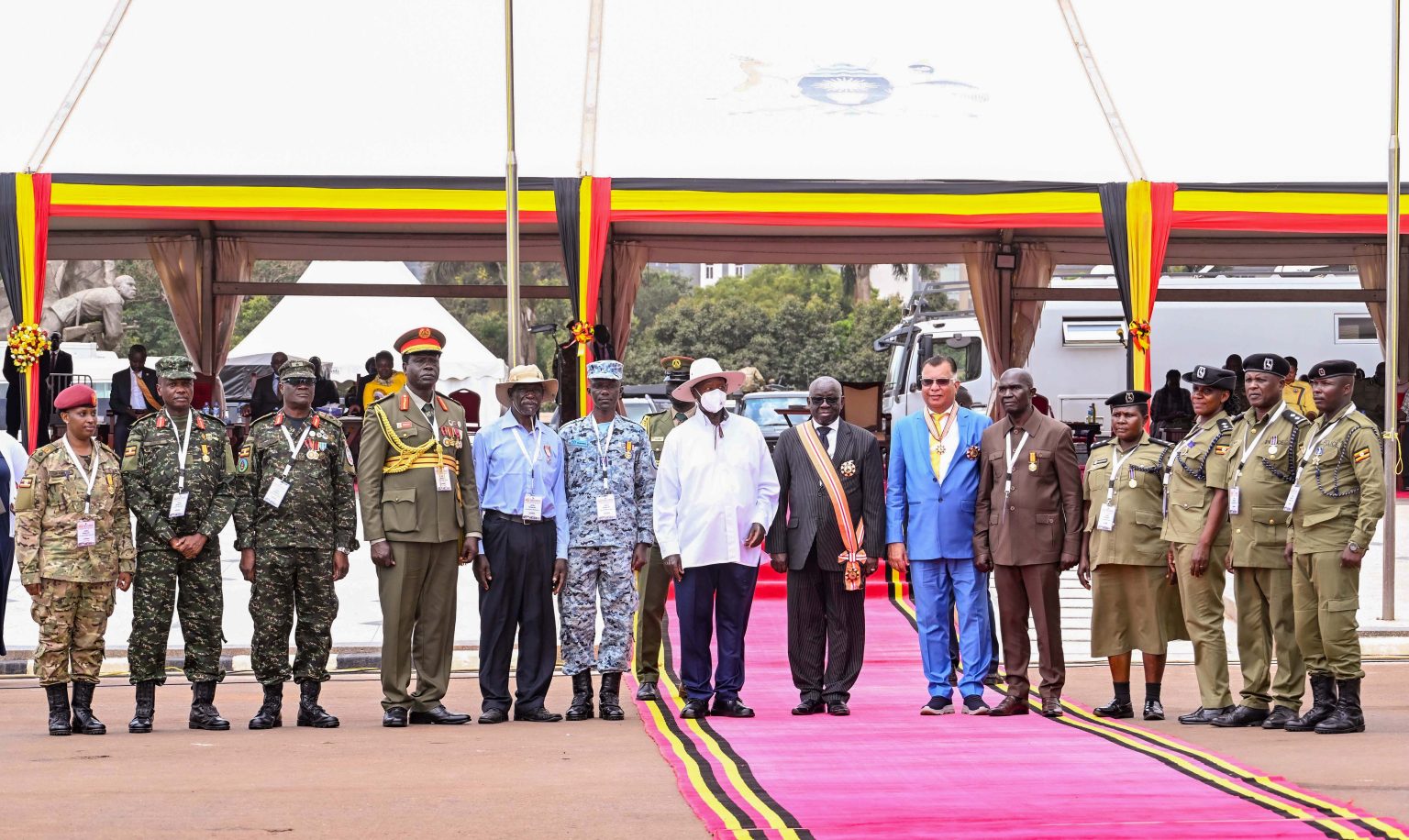
During the ceremony, 33 Ugandans were awarded national medals in recognition of their contribution to the liberation struggle and national development.
January 26 marks the day in 1986 when National Resistance Army fighters captured Kampala, ending the UNLA junta led by the late Gen Tito Okello Lutwa. President Museveni, who led the NRA, was later sworn in as Uganda’s ninth President.
The celebrations were attended by Vice President Jessica Alupo, Speaker of Parliament Anita Among, Chief Justice Flavian Zeija, Prime Minister Robinah Nabbanja, senior NRM leaders, ministers, security chiefs, diplomats, religious and cultural leaders, and former national leaders.